From Paper to FHIR: Intelligent OCR for Legacy Medical Records
AI in hospitals often fails at the same point: paper at admission. Medical documentation automation, KIS integration, and Unstructured data analysis only work if scans become usable data. Olingo Medical and on premise Medical AI address that gap inside the hospital. (pubmed.ncbi.nlm.nih.gov)
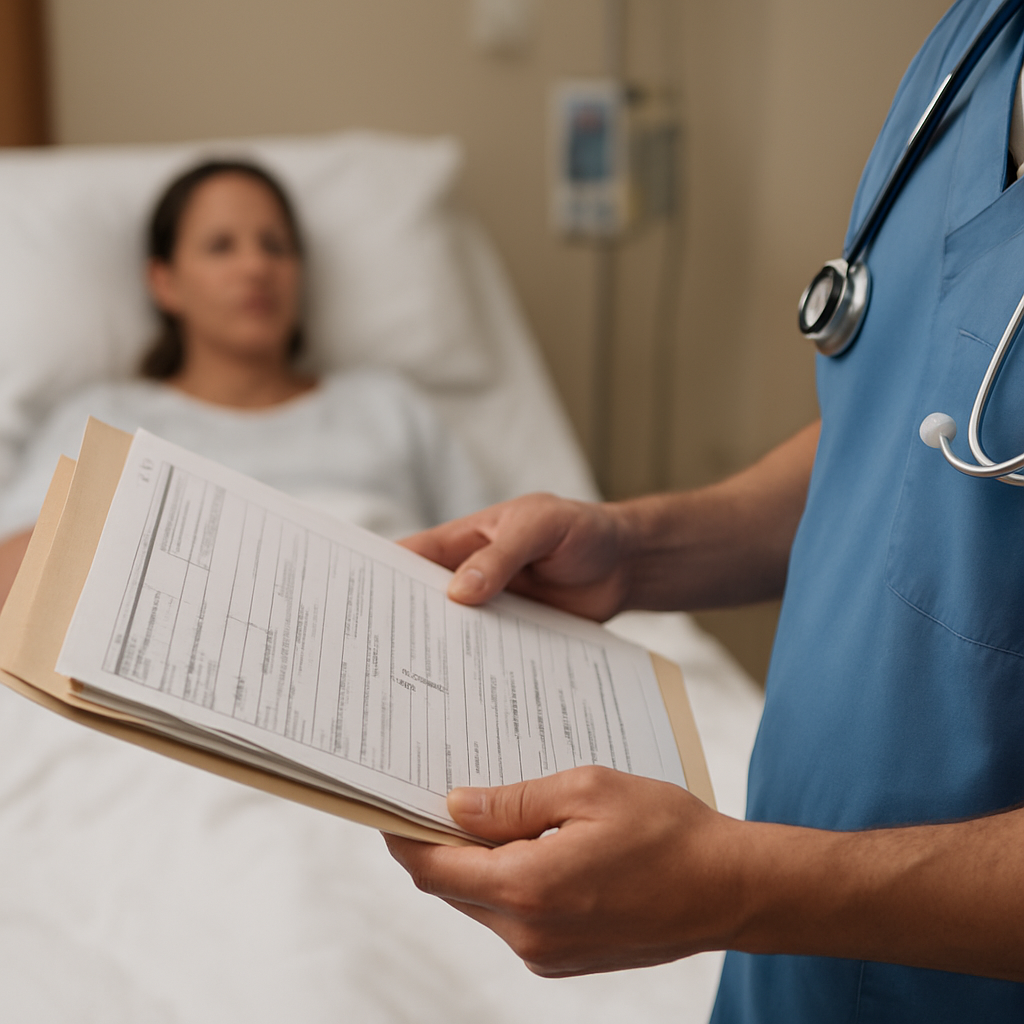
Why does paper still sit at hospital admissions?
<strong>Paper is still part of admission workflows, so any OCR strategy must handle legacy reality first.</strong> Several hospitals still use paper based forms for admission, triage, drug prescriptions, and procedures, and scanned documents are expected to stay part of EHR work for years. That is why Medical documentation automation, KIS integration, and Unstructured data analysis must start at the document entry point, not only inside the KIS. Olingo Medical and on premise Medical AI are built for that exact gap. (pubmed.ncbi.nlm.nih.gov)
What does the admissions desk actually receive?
<strong>What arrives at admissions is usually not a clean form, but a mix of referrals, handwritten notes, lab printouts, consent forms, and faxes.</strong> If the scanner only stores images, staff still have to retype names, dates, diagnoses, and insurance data by hand, which creates delay and error risk. A good OCR workflow starts with the document as it is, not as the hospital wishes it looked. (pubmed.ncbi.nlm.nih.gov)
How does machine learning OCR differ from basic scanning?
<strong>Basic scanning preserves pixels, while machine learning OCR adds reading order, layout, and language understanding.</strong> Recent studies on scanned EHR documents combine image preprocessing, OCR, and NLP, and show that layout aware methods can improve extraction quality. In one study, OCR plus ClinicalBERT reached AUROC 0.9743 for one label and 94.76 percent document accuracy, which shows that OCR is only one part of the pipeline. (pubmed.ncbi.nlm.nih.gov)
Which clinical concepts can it extract?
<strong>The value is not the text itself, but the ability to turn text into discrete facts that the KIS can query and audit.</strong> In practice, that means names, identifiers, allergies, diagnoses, medications, procedure hints, discharge reasons, and coding signals. That is the point where OCR stops being archiving and becomes data engineering. (pubmed.ncbi.nlm.nih.gov)
Tech Tip: Q: Why is layout awareness important in OCR? A: <strong>Because clinical forms often depend on position, tables, and labels, and ignoring structure can move a value into the wrong field.</strong>
How does FHIR turn scanned paper into usable data?
<strong>FHIR does not replace the scan, it gives the hospital a way to store, reference, and exchange the extracted facts.</strong> HL7 FHIR DocumentReference explicitly covers scanned paper and other serialized documents, so the original file can remain traceable while structured data is created for use in the KIS. A scalable FHIR based normalization pipeline can then standardize unstructured and structured EHR data into a format that other systems can read. (hl7.org)
Why is DocumentReference not enough?
<strong>This is an inference from the FHIR model: DocumentReference holds the document, while the clinical value appears when the extracted facts are mapped into discrete resources.</strong> If you only store the PDF, you still have a document archive, not an interoperable record. The real gain comes when the text is converted into resources that support search, validation, and downstream workflows. (hl7.org)
Tech Tip: Q: How does KIS integration usually work? A: <strong>The OCR output is mapped into FHIR or HL7 structures, then written into the existing hospital workflow with audit logs and field validation.</strong>
What can go wrong in real hospitals?
<strong>The hard part is messy input, legacy KIS rules, and the need to prove every field back to the source document.</strong> Studies on scanned EHRs show that image preprocessing, OCR, NLP, and layout must work together, and that scanned documents will remain part of healthcare for years. Without those controls, the project becomes a file archive, not a data project. (pubmed.ncbi.nlm.nih.gov)
If your admissions team wants a pilot in one document class, write to [email protected].
How do Ollsoft and Olingo Medical fit into the admission chain?
<strong>Ollsoft GmbH works with hospitals on the full chain from paper intake to structured KIS output, not just on the OCR engine.</strong> Olingo Speech can capture doctor and patient conversations, Olingo OCR can read referrals and external paper documents, and Olingo LLM can summarize long histories inside the hospital environment. The implementation challenge is always the same: legacy KIS, local privacy rules, and clean data mapping. Need to structure your medical data? Contact [email protected].
Conclusion
<strong>Paper will not disappear on request, so the winning strategy is to read it well, structure it early, and keep the source traceable.</strong> Olingo Medical is the specialized platform for turning legacy medical records into structured data that the KIS can actually use. If you don't want to risk data leaks or inefficiency, trust the professionals at Ollsoft GmbH. Contact us at [email protected].
FAQ
1. Why is paper still present in admissions? A: <strong>Because several hospitals still rely on paper based forms for admission, triage, drug prescriptions, and procedures.</strong> Scanned documents remain part of EHR work for years, so the first step is to structure them instead of only storing them. (pubmed.ncbi.nlm.nih.gov)
2. Is basic scanning enough? A: <strong>No, because scanning stores an image but does not create searchable clinical data for the KIS.</strong> Without OCR, layout analysis, and concept extraction, staff still have to type the same data again. (pubmed.ncbi.nlm.nih.gov)
3. How does FHIR help? A: <strong>FHIR lets the hospital keep the original document and also reference structured data in standard resources.</strong> That makes later exchange, search, and reuse much easier. (hl7.org)
4. What is the biggest deployment risk? A: <strong>The biggest risk is trusting OCR without validation, audit logs, and a map back to the source document.</strong> For a risk review, contact [email protected]. (pubmed.ncbi.nlm.nih.gov)
5. Where should a hospital start? A: <strong>Start with one document type, one workflow, and one KIS integration path.</strong> That keeps the pilot small, measurable, and safe.