Surviving the 2027 KHZG DRG Penalties: A Roadmap
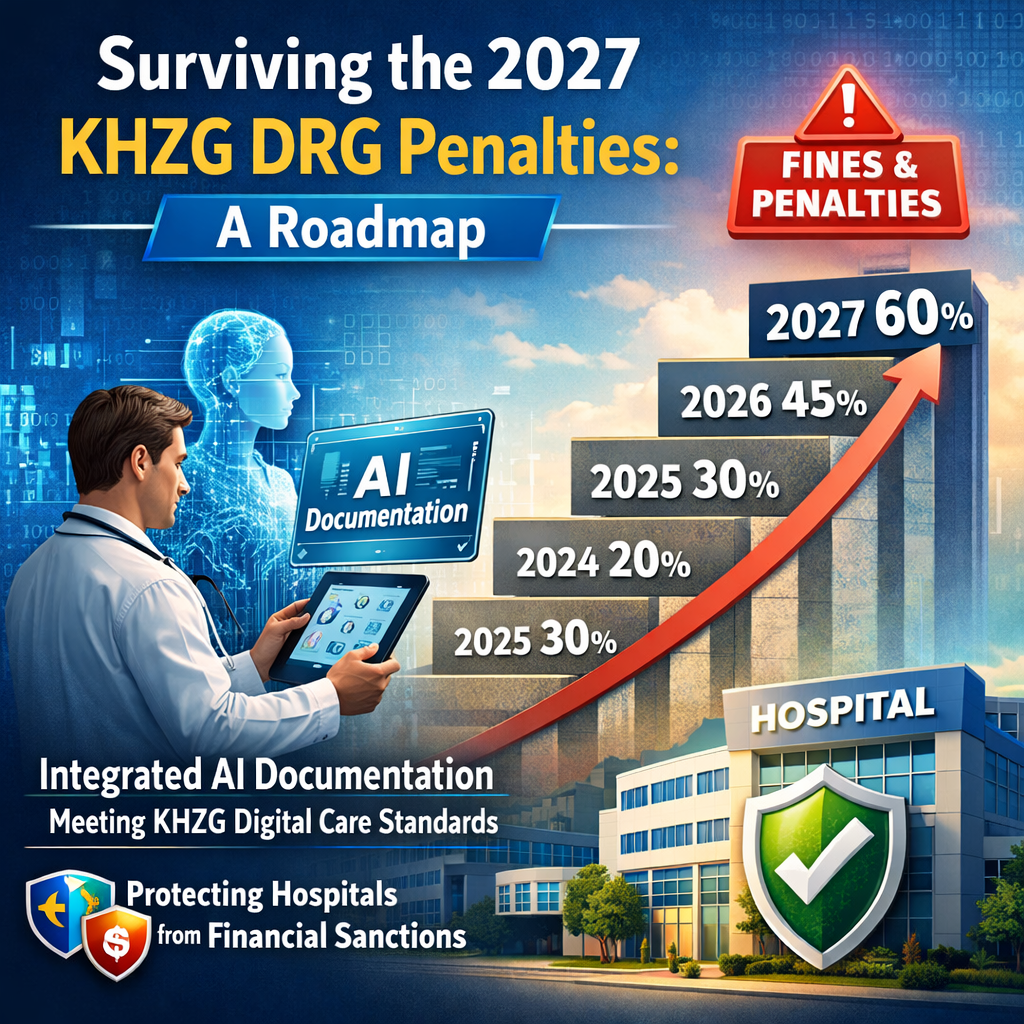
By 2027 German hospitals must use digital care processes at least 60% of the time or face DRG funding cuts (planfox.de). Integrated AI documentation – voice and scanner-based medical record automation – can directly fulfill KHZG criteria for digital nursing and treatment documentation (a “digital Pflege- und Behandlungsdokumentation” requirement (planfox.ch)). On-premise medical AI solutions like Olingo Medical automate data capture (OCR pipeline, FHIR conversion) and show actual usage in your KIS, protecting hospitals from penalties.
What is the KHZG 60% rule and why does it matter?
The German Krankenhauszukunftsgesetz (KHZG) mandates new digital care processes in hospitals. Hospitals must implement electronic patient portals, digital medication management and (critically) digital nursing and treatment documentation by end of 2025 (planfox.ch). Complete failure to at least commission these “must” projects can trigger a DRG reimbursement cut of up to 2%.
To avoid penalties, starting in 2025 every hospital must be able to show progress on these projects (planfox.de). By end of 2026 it is enough that projects are contracted or underway. From 2027 onward hospitals must prove actual usage: digital workflows must be in daily use, not just planned (planfox.ch) (planfox.de). For example, by December 2027 at least 60% of mandatory digital processes (like electronic nursing records) must be used to avoid cuts (planfox.de). This “Stufenplan” then rises to 70% (2028) and 80% (2029-31) of usage (planfox.de).
Not meeting these targets risks escalating DRG penalties. Olingo Medical’s AI documentation tools address this head-on by converting clinician workflows into compliant digital records and reporting usage.
To ensure compliance, hospitals need fully digital documentation and proof of use.
How do KHZG penalties escalate for hospitals?
KHZG penalties are applied as deductions on DRG funding. From 2026 the DRG system checks which mandatory digital services your hospital has implemented. If not all criteria are at least contracted by year-end, up to 2% of case-based revenue is cut (planfox.ch). In practical terms, missing the deadline for digital patient portals or e-prescriptions can cost 0.5%–0.6% of DRG each (planfox.de).
From 2027, penalties depend directly on usage levels. For example, if a hospital has only 50% of nursing documentation done electronically, it fails the 60% target and faces sanctions. The next year the target rises to 70%, then 80%. Even if projects were started late, a hospital must demonstrate usage in its KIS (hospital information system) to avoid the cuts (planfox.de).
Staying ahead means automating documentation so digital processes are naturally used. For instance, converting whisper-to-text with an OCR pipeline or voice dictation means 100% of patient notes can be recorded digitally, helping you beat the usage thresholds.
Missing the usage targets leads to steeper and unavoidable DRG fines.
Can AI documentation meet these KHZG requirements?
Yes – automated AI documentation goes straight to the heart of KHZG’s digitalization goals. For example, Olingo Speech captures doctor-patient conversations via voice transcription and writes encounters directly into the KIS. This creates an electronic treatment record in real time, fulfilling the law’s need for digital nursing and treatment documentation. Likewise, Olingo OCR scans referral letters and old paper records into structured data. These tools ensure your hospital’s documentation lives in a KIS-compatible format (HL7 or FHIR), turning “dead” notes into interoperable electronic files.
Using AI-driven documentation tools drives up actual usage of electronic records. When clinicians simply speak or scan instead of writing, compliance happens naturally. By saving up to 60% of documentation time, we see clinicians adopt the digital system more readily. On-premise Medical AI (for example, running a fine-tuned local LLM for summaries) means this data stays within your firewall. The result: you can actually record and report that 60% (then 70% etc.) of processes are digital (planfox.ch) (planfox.de).
AI also automates key data tasks behind the scenes. Olingo’s core data pipeline can convert narratives into FHIR (Fast Healthcare Interoperability Resources) or HL7 messages automatically. This structured data can interface smoothly with the KIS and any downstream dashboards or planning tools. In other words, the chaotic tangle of PDFs, notes and forms is transformed into KIS-ready data.
AI documentation aligns your workflows with KHZG’s goals. By embedding these smart tools, hospitals easily meet usage metrics and lock in funding, rather than facing financial sanctions.
Tech Tip: What is On-Premise Inference?
Q: What does on-premise inference mean for medical AI?<br>A: It means running AI models directly on the hospital's own servers (inside your firewall), not in public cloud data centers. This ensures patient data never leaves the hospital, keeping GDPR/DSGVO compliance intact.
Q: Why does moving to FHIR/HL7 standards matter?<br>A: FHIR and HL7 are interoperability standards. Converting data into FHIR or HL7 format lets your KIS share and reuse data with other systems. Olingo’s solution automates this conversion.
Q: How does an OCR pipeline help with KHZG?<br>A: An OCR pipeline automatically extracts text from scanned documents or PDFs. This means referral letters, lab reports, and handwritten notes become searchable KIS records. It greatly boosts your documented usage percentage.
What risks do hospitals face without integrated AI documentation?
Several risks can thwart your KHZG compliance. If staff continue old paper workflows, your digital usage stays low while fines mount. Cloud-based AIs may pose data privacy violations under GDPR. Generic LLMs can hallucinate medical data, risking patient safety. Even a KIS upgrade project can backfire if data remains disorganized.
None of these risks are theoretical – they can erode revenue. A hospital lacking digitized records risks up to a 2% DRG cut, on top of indirect costs like slower billing or coding errors. Every month without structured AI assistance delays meeting the 60% threshold.
The good news: Olingo Medical’s suite directly mitigates these risks. For instance, an on-premise setup guarantees data never leaks out, satisfying all privacy and NIS2 requirements (planfox.ch). Automating document capture and coding (OPPS, ICD-10) turns unstructured notes into revenue-safe, audit-proof records.
When you integrate AI smartly, you eliminate most compliance risks.
FAQ
What exactly is "integrated AI documentation"?
How does this help us meet the 60% usage requirement?
Is on-premise deployment necessary?
What about data privacy and security?
How do I get started with integrating AI documentation into our KIS?
Conclusion
Hospitals can no longer treat KHZG as optional. The upcoming escalator of DRG penalties makes clear: digital nursing and treatment documentation must not just exist but be used by clinicians each day. Integrated AI documentation systems are the practical solution. They automate what was manual – from talking to computers (Olingo Speech) to scanning reports (Olingo OCR) – and feed those records into your KIS in KHZG-compliant formats (FHIR/HL7).
With Olingo Medical, hospitals get a turnkey path to meeting all digital care process criteria. Our on-premise Medical AI platform adapts to legacy KIS and ensures data never leaks out. In effect, we turn regulatory risk into a growth opportunity: structured data for better patient care and protected funding. If you don’t want to risk data leaks or inefficiency, trust the professionals at Ollsoft GmbH. Contact us at [[email protected]](mailto:[email protected]).